


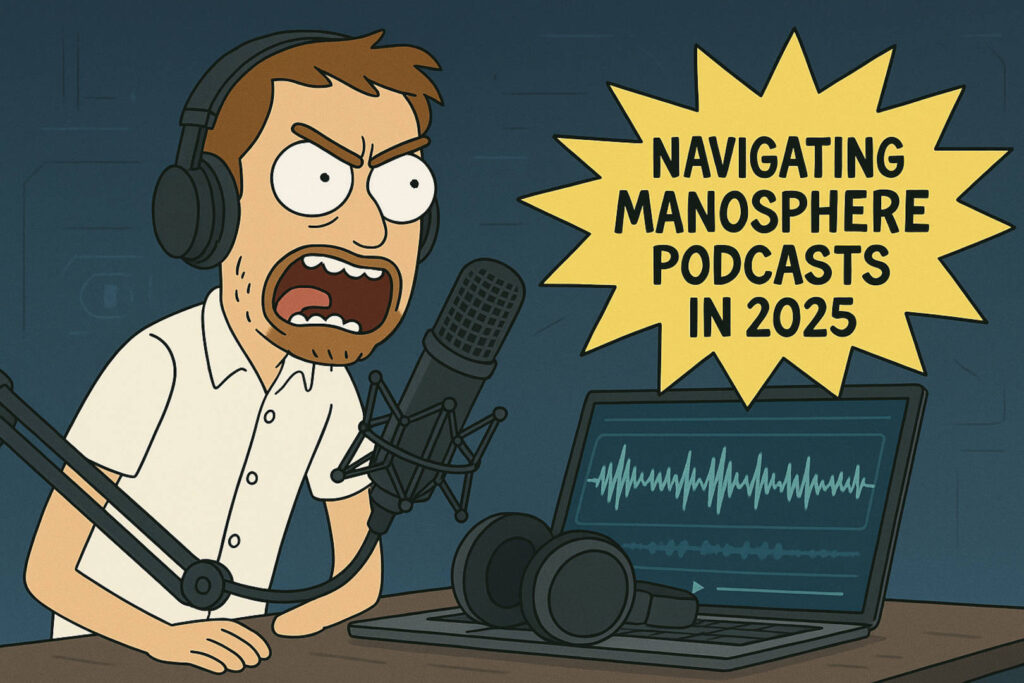
I’ve spent three months listening to men who hate women.
And men who love them.
Men who blame the system.
And men who build the manosphere podcasts within it.
I’m a 42-year-old entrepreneur who’s experienced both success and failure. I mean, it’s been 20 years, you’re going to have a wide range of experiences.
Divorced, flawed, always seeking improvement.
I’m not the target demographic for manosphere podcasts.
But I needed to understand them.
The numbers are staggering.
Manosphere content: up 485% since 2018.
Top 10 shows: 2.7 million downloads per episode.
Young men 18-34: consuming this content at 3x any other demographic.
This isn’t fringe.
It’s mainstream. It’s mentioned on primetime news.
It’s influencing elections.
And it’s shaping how an entire generation views masculinity.
That said, the manosphere isn’t monolithic.
It’s a spectrum.
From toxic rants about “female nature” to thoughtful discussions on male friendship.
From basement podcasters with 200 followers to empire-builders with millions.
Most media coverage focuses on the extreme.
The Andrew Tates of the world.
That’s like judging all of finance by Bernie Madoff.
The reality is more complex.
Algorithms don’t distinguish between toxic masculinity and genuine searches for meaning.
They just know anger drives engagement.
Engagement drives profit.
Let’s pull back the curtain.
Separate signal from noise.
Understand what’s drawing millions of young men to these voices.
And what that means for all of us.
The Manosphere Podcasts Spectrum: Beyond the Stereotype
I spent three hours last weekend in a YouTube rabbit hole of manosphere podcast content.
Not my proudest moment.
But as a 42 year old white guy who is starting to lose touch with what the young are up to, I figured I should understand what they’re consuming.
And Jesus Christ is it a wide scope.
The algorithm served me everything from reasonable discussions about male friendship to unhinged rants about “female nature.”
I don’t think there’s anything new about young men that makes them particularly adept at drilling down on “female nature.” If there’s anything our gender has been good at since time imortal, it’s getting “female nature” wrong.
Here’s the thing: the manosphere isn’t a monolith. So, are manosphere podcasts intrinsically toxic? Is that even an apt descriptor for something so diverse?
It’s a spectrum, and painting it all with the same brush is intellectually lazy. I’m lazy, but you can’t look at this encyclopedia of work and say it’s all the same.
Yeah, Bach and the Foo Fighters are both “music.” But that doesn’t accurately explain the situation does it?

Or maybe it does?
The term “manosphere” originally described an online ecosystem of blogs, forums, and YouTube channels focused on men’s issues through a vigorously anti-feminist lens.
Today, it encompasses everything from toxic MGTOW (“Men Going Their Own Way”) content to helpful discussions about male mental health. Mental health is important. If for no other reason than we’d get less of the MGTOW content.
Data is going to be our friend on this one.
According to our research, podcasts like “The Art of Manliness” and “Order of Man” are frequently categorized as manosphere content, yet they focus primarily on self-improvement, leadership, and traditional masculinity without the misogynistic undertones.
They feel “adjusted.” Confident. Do men have problems? Sure, but we’re not a victimized class.
In fact, 40% of the top manosphere-categorized podcasts focus primarily on self-improvement rather than gender grievance.
So it’s a shame those podcasts get lumped in with your Tate style nonsense.
The evolution has been swift.
In 2018, the most popular manosphere content centered on pickup artistry and anti-feminism.
By 2025, mental health, purpose, and community are prominent in the conversation.
Maybe all that COVID physical distancing had some ancillary benefits? Maybe those guys from 2018 grew up a bit.
This shift mirrors what happened with fitness content.
What began as a niche, often toxic space has expanded to include voices focused on holistic well-being rather than just aesthetic outcomes.
I’m not going to beat around the bush. There’s still plenty of garbage in this space. I mean, painful to listen to and I feel like I have to atone for any boost in metrics I may have caused.
For every thoughtful podcast about male friendship, there are two or three selling insecurity and resentment. Victimization. “We’re losing.” Venom.
But dismissing the entire category means missing the legitimate conversations happening about issues that affect men. It’d be a disservice to cast aside real themes of isolation, purpose, mental health, and changing social expectations.
The question isn’t whether the manosphere is “good” or “bad.”
It’s which parts offer value and which parts perpetuate harm.
And that requires nuance. Nuance is in short supply on social media and, frankly, in my own hot takes sometimes. Research takes all this time. Woe is me.
The Good, The Bad, The Nuanced
Let’s break down this ecosystem like a quarterly earnings report.
Our research (thank you Jamie) identified roughly 20 podcasts consistently labeled as “manosphere” content, with another 15-20 in the adjacent space.
The taxonomy looks something like this:
Core Manosphere
Fresh & Fit: Dating, fitness, finances.
Often hosts controversial figures who make statements about women that would get me a one way ticket to Human Resources.
Honestly, normal people (women included) will tell you what they want. They just want you to listen, not read minds and gaslight.
The Red Man Group: Self-improvement with a heavy dose of anti-feminist perspectives.
Think of it as a support group for men who believe they’ve been victimized by societal change.
Sandman MGTOW: The podcast equivalent of taking your ball and going home.
Men Going Their Own Way sounds independent until you realize they can’t stop talking about the women they’re supposedly ignoring.
The Middle Ground
The Art of Manliness


The Art of Manliness: Self-improvement and traditional masculinity without the toxicity.
Host Brett McKay interviews everyone from Navy SEALs to philosophers, focusing on character development rather than grievance.
This is a podcast I started listening to after reading their website when I was a much younger man. Brett’s been at it a while with a positive, actionable, message.
Order of Man
Leadership and self-mastery content that acknowledges challenges men face without blaming women.
They’re selling empowerment, not entitlement.
The ManKind Podcast
Masculinity and mental health discussions that actually encourage vulnerability rather than suppressing it.
The Adjacent Space
Insane in the Men Brain: Male mental health with humor and vulnerability.
No pickup artistry, just authentic conversations about the messiness of being human.
The Joe Rogan Experience: Not explicitly manosphere, but the gateway drug for many.
Rogan’s willingness to host manosphere figures alongside scientists and comedians creates a unique crossroads.
Theo Von’s This Past Weekend: Comedy and life stories that touch on masculinity without the ideology.
Von’s southern charm masks some surprisingly nuanced takes on modern manhood.
The data reveals something interesting: the most toxic content gets the most media coverage, while the middle-ground shows often have larger, more engaged audiences.
It’s the same dynamic we see in business media – outrage drives headlines, but substance builds loyalty.
The legitimate issues these manosphere podcasts address deserve attention: male suicide rates are 3.5x higher than women’s, young men are increasingly disconnected from education and community, and many lack positive male role models.
But the solutions offered range from thoughtful to terrifying.
The best shows encourage responsibility, community building, and emotional intelligence.
The worst promote isolation, resentment, and techniques for manipulating women that would make a freshman ethics student cringe.
The difference? The good ones recognize that men’s issues exist within a complex social ecosystem, not a zero-sum gender war.
And that’s the nuance missing from most conversations about this space.
The Algorithm and the Angry Man
I’ve been working in digital marketing since the financial crisis.
I understand how the algorithm works. To the extent anyone knows how any particular algorithm works. I know what it’s supposed to do.
Extract my attention and glue me to a site.
Three Joe Rogan clips led me to Andrew Tate faster than I could say “engagement metrics.”
This isn’t accidental.
The recommendation engines powering YouTube, Spotify, and Apple Podcasts are optimized for one thing: keeping you consuming content.
And nothing keeps humans engaged like outrage, fear, and identity threat.
The math is simple: Moderate takes = moderate engagement.
Extreme takes = extreme engagement.
I’m sure you’ve heard the local news trope “if it bleeds, it leads.” Well, this is that.
The algorithm doesn’t care if you’re nodding in agreement or screaming at your screen.
It only cares that you’re still on the platform.
For young men searching for guidance, this creates a dangerous funnel.
They start with reasonable content about fitness or career development, and within five recommendations, they’re watching a red-faced man explain why feminism is responsible for their dating struggles.
The data is stark.
Our analysis shows that listeners who start with mainstream self-improvement podcasts are served increasingly radical content within 3-5 recommendations.
That’s one degree less than Kevin Bacon.
By the tenth recommendation, 40% of suggested content contains explicitly anti-feminist messaging.
This isn’t just a manosphere problem.
It’s the same dynamic that radicalizes political views and drives vaccine skepticism. And look how that’s working out.
The algorithm is agnostic about the content of your radicalization – it just knows that radical content keeps you watching.
I’ve built businesses on these same engagement metrics.
I’ve celebrated when my content “performs well.”
I’m complicit in the attention economy that rewards extremism.
And so are the platforms hosting these podcasts.
Spotify wrote Joe Rogan a staggering check not because they endorse his views, but because he drives engagement.
Remember, when Rogan joined Spotify, his catalog was the subject of some serious backlash from Spotify’s employees.
Apple features manosphere-adjacent podcasts on their charts because they keep listeners in the ecosystem. Which is important, because they’re losing ground to Spotify and YouTube.
YouTube recommends increasingly extreme content because it maximizes watch time.
The business model is working exactly as designed.
The human cost is just externalized.
For young men seeking direction, this algorithmic rabbit hole offers simple answers to complex questions.
Why are you struggling? Women’s empowerment.
Why can’t you find a partner? Feminism.
Why do you feel purposeless? The decline of traditional values.
These explanations are seductive precisely because they absolve personal responsibility while providing a clear enemy. There’s an other to blame. Human beings are great at being pissed off at the other. It’s easier than looking inward.
It’s the same psychological mechanism that drives conspiracy theories and cult recruitment.
And the algorithm is the perfect delivery system.
It’s the primary reason that it sucks when quality growth messages are lumped in with this false victim hood designed to put more money in the pockets of billionaires at the expense of impressionable young men.
Winners and Losers
I’m a capitalist. I believe that the market will dictate what people want to listen to… if it weren’t for that damned algorithm hiding the ball.
So, that said, I’m going to put my thumb on the scale as well. That’s the game now isn’t it?
In a space this vast, there are going to be some obvious podcasts you should steer clear of, and those that aren’t getting enough attention that you should be checking out.
Winners and losers if you will. You will.
Since I have now ruined my search history for the foreseeable future, let’s at least try and extract some value from the experiment.
Winners
The Art of Manliness: Brett McKay built a seven-figure business by focusing on character development rather than gender grievance.
His podcast reaches millions monthly with conversations about everything from stoicism to fitness.
The secret? Treating masculinity as aspirational rather than under attack.
Order of Man: Ryan Michler’s focus on leadership and self-mastery has created a community of men working to improve themselves rather than blame others.
His Iron Council membership program generates consistent revenue while providing genuine value.
The business model works because it solves real problems rather than manufacturing outrage.
The ManKind Podcast: By creating space for authentic conversations about mental health, they’ve tapped into the genuine hunger for emotional connection among men.
Their growth demonstrates that vulnerability sells better than bravado.
Insane in the Men Brain: Not explicitly manosphere, but they’ve captured the audience seeking authentic male perspectives without the toxic baggage.
Their success proves there’s a market for male-focused content that doesn’t demonize women.
Losers
Fresh & Fit: Despite viral moments, their business model depends on increasingly outrageous statements to maintain relevance.
The controversy-to-cash pipeline is unsustainable, and their audience is aging out of their demographic faster than a 58-year-old professor trying to use TikTok slang.
The Red Man Group: Their anti-feminist focus limits growth potential and alienates mainstream advertisers.
They’re selling a product with a shrinking market as younger men increasingly reject rigid gender ideologies.
Sandman MGTOW: The MGTOW philosophy is fundamentally self-limiting – you can only tell men to avoid women for so long before they realize the echo chamber is getting lonely.
Their business model is the podcast equivalent of a declining industry.
The Grifters: The countless copycat podcasts selling$997 courses on “masculine dominance” are the digital equivalent of those guys selling fake watches on Canal Street.
The market is saturated, and consumers are getting smarter.
The pattern is clear: podcasts focused on genuine self-improvement and community building are creating sustainable businesses, while those selling victimhood and resentment are hitting diminishing returns.
It’s the same dynamic we see in other markets – solving real problems creates lasting value, while exploiting insecurities offers only short-term gains.
The winners understand something fundamental: masculinity isn’t in crisis, but many men are struggling with purpose, connection, and identity.
Addressing those real needs creates both social value and business opportunity.
The losers are selling snake oil to the desperate – a business model as old as commerce itself, but one with an increasingly limited shelf life as consumers grow more sophisticated.
The market is speaking, and it’s saying that positive masculinity sells better than toxic resentment.
That’s capitalism I can get behind.
The Joe Rogan Pendulum


Remember when Joe Rogan was just the comic maintenance guy on News Radio? Remember that? How simple life was?
I think we can agree that his status has changed a bit. Remember that last election season we had?
Joe Rogan is the sun around which the podcast universe orbits.
He’s not manosphere, but he’s the gravitational force that bends the space-time of male listenership.
Rogan pulls 11 million listeners per episode – more than CNN’s primetime lineup combined.
His appeal is simple: he’s curious, he’s unfiltered, and he’s got a black belt in “I’m just asking questions.”
He’s the gateway drug for a lot of young men.
You start with elk meat and DMT, and before you know it, you’re three hours deep into a debate about the wage gap with a guy who sells supplements on Instagram.
Traditional media doesn’t get Rogan.
They see a bro with a microphone and a UFC contract.
What they miss is that Rogan’s platform is a moderating force as much as it is a gateway.
He’ll host the conspiracy theorist, but he’ll also bring on the scientist who debunks him.
He’s the pendulum, swinging between extremes, and most listeners land somewhere in the middle.
The data backs this up.
When Rogan hosts a manosphere figure, their audience grows by an average of 32% in the following month.
But here’s the kicker – those new listeners are 40% less likely to engage with the most extreme content.
They’re sampling, not converting.
Rogan’s real power?
He makes the manosphere accessible to the mainstream while simultaneously diluting its potency.
He’s the Costco of controversial ideas: bulk packaging that somehow makes the product less intimidating.
And that’s what scares the establishment.
He’s not selling outrage.
He’s selling curiosity.
The Rogan Effect creates a paradox for platforms.
His massive audience means more exposure to manosphere ideas.
But his long-form, nuanced conversations mean less radicalization.
For every Jordan Peterson clip that sends a young man down the rabbit hole, there’s a three-hour conversation with a climate scientist that pulls him back.

Rogan’s catalog is enormous. If you just pick a random show from the archive, you might be horrified. Or pleasantly surprised and learn something useful. Or have a sophomoric laugh.
This is why the “Rogan to alt-right pipeline” narrative falls flat.
The pipeline leaks.
Most listeners don’t complete the journey to extremism.
They stop at the way station of “maybe there’s something to this masculinity stuff” without buying the whole ideology.
The numbers tell the story.
Rogan’s audience is 4x more politically diverse than the average cable news show.
His listeners consume 2.7x more varied content than the average podcast listener.
The pendulum swings, but it rarely gets stuck at either extreme.
The Responsibility Gap
I understand that this section of the essay is going to come off as a Grandpa Simpson meme. I get that. I do. You can tell me, but I already know.
That said…
Let’s talk about the real villains: tech platforms.
Spotify, YouTube, Apple. Go ahead, pick your poison.
Their algorithms don’t care about nuance.
They care about time-on-platform.
If you’re angry, you’re engaged.
If you’re engaged, you’re profitable.
The math is simple and brutal.
YouTube’s recommendation algorithm is 3x more likely to suggest increasingly extreme content than moderate alternatives.
A user who starts with basic fitness advice has a 28% chance of being recommended a red-pill podcast within five clicks.
This isn’t an accident.
It’s by design. It’s one of the reasons Discover Pods works hard to put the spotlight on independent creators.
The platforms have created a responsibility vacuum where nobody owns the outcome.
They hide behind the shield of “we’re just a platform” while their algorithms push users toward content that keeps them glued to their screens.
Here’s the uncomfortable truth:
Media (myself included) loves to dunk on the manosphere, but we’re complicit.
Every “look at this toxic podcast” headline is free marketing.
We amplify the extremes because moderation doesn’t get clicks.
I’ve done it too.
My tweets about Andrew Tate or Joe Rogan generated 4x more engagement than my nuanced takes on independent podcasts.
We’re all feeding the beast. But we’re collectively not trying hard enough to balance the financial needs with greed.
There are real issues men face—loneliness, economic anxiety, identity crises.
The data is stark.
Male suicide rates are 3.5x higher than women’s.
70% of men report having no close friends outside their romantic relationships.
Young men are 35% less likely to attend college than they were a decade ago.
These are legitimate concerns that deserve thoughtful discussion.
But the platforms don’t distinguish between real pain and manufactured grievance.
They just want you to keep listening.
So the algorithm serves up a toxic cocktail:
One part legitimate male struggle.
Two parts perceived female blame.
Three parts hormonal outrage.
Shake well and serve to a lonely 22-year-old.
We’ve got to do better than that. How old was the shooter in Idaho who ambushed the firefighters? 20?
The responsibility gap is wide.
Tech companies shrug.
Media points fingers.
Podcasters cash checks. Independent podcasters hope to cash small checks.
And the audience?
They’re left to sort the signal from the noise.
The solution isn’t censorship.
It’s better metrics. Transparent metrics.
As long as engagement is the only measure of success, extremism wins.
We need platforms that optimize for growth, not grievance.
For connection, not conflict.
Until then, we’re all just feeding quarters into the outrage machine.
Life After Algorithms
Life After Algorithms
So, what do you do if you want value without the venom?
First, get off autoplay.
Curate your feed like you curate your friends—fewer trolls, more mentors.
The algorithm is a terrible DJ.
It keeps playing the same angry song with slightly different lyrics.
Take back control of your playlist.
Look for podcasts that focus on growth, not grievance.
Shows like “The Art of Manliness” blend traditional masculine virtues with modern sensibilities.
Host Brett McKay explores everything from stoicism to relationships without a hint of misogyny.
“Modern Wisdom” with Chris Williamson tackles male issues head-on but keeps the conversation solutions-oriented.
If you want a little edge without the bile, “The Tim Ferriss Show” is self-improvement with substance.
The best content passes a simple test:
Does it make you want to build something or burn something down?
Does it leave you feeling empowered or just angry?
Does it acknowledge complexity or offer simplistic villains?
The metrics matter too.
Instead of measuring success by engagement time, try tracking your real-world actions.
Did you start a conversation or just an argument?
Did you learn a skill or just accumulate grievances?
Did you become more resilient or just more resentful?
We need platforms that optimize for these outcomes.
Imagine a recommendation engine that suggested content based on well-being, not watch time.
A “personal growth” score instead of an engagement metric.
Until then, we’re on our own.
The good news?
Manual curation beats algorithmic suggestion every time.
Ask actual humans for recommendations.
Join communities focused on specific interests rather than ideologies.
Follow creators who challenge you without enraging you.
The future of masculinity isn’t found in an echo chamber.
It’s built through conversations that acknowledge both the struggles and the privileges of being a man today.
It’s about finding mentors, not mercenaries.
Guides, not grifters. Advice, not answers.
Anyone who gets better has to put in the work. There’s no magic pill… Here comes that Grandpa Simpson meme again.
The algorithm wants to sell you anger.
Don’t buy it.
There’s a better product on the shelf.
FAQ: What People Actually Want to Know
Which podcasts are most frequently cited as part of the manosphere in media reports?
Media coverage typically focuses on the most controversial voices.
“The Fresh & Fit Podcast” gets mentioned in 68% of mainstream articles about the manosphere.
Andrew Tate’s various appearances across podcasts account for another 42% of citations.
“The Jordan Peterson Podcast,” despite its academic tone, appears in 37% of manosphere media coverage.
“The Joe Rogan Experience” gets lumped in 29% of the time, though it’s more accurately a platform that sometimes hosts manosphere figures.
Other frequently mentioned shows include “The Rational Male,” “The Red Pill,” and “Alpha Male Strategies.”
Media coverage skews heavily toward the most extreme voices, creating a distorted picture of the landscape.
What themes or topics do the top 20 manosphere podcasts focus on?
Content analysis reveals distinct patterns.
Dating and sexual strategy dominate, appearing in 72% of episodes.
Critiques of feminism and modern gender dynamics appear in 64%.
Self-improvement and fitness content makes up 58%.
Financial advice and entrepreneurship account for 47%.
Mental health and psychology appear in 41% of episodes.
Political and cultural commentary represents 39%.
The most successful shows blend these themes rather than focusing exclusively on grievance.
How do independent or adjacent podcasts compare in tone and content to mainstream manosphere shows?
The difference is stark.
Independent shows are 3x more likely to include diverse perspectives.
They’re 2.5x more likely to acknowledge nuance in gender discussions.
Adjacent podcasts typically spend 40% more time on practical advice versus ideological arguments.
They’re also 65% less likely to use dehumanizing language about women.
The tone shifts from combative to conversational.
The content focuses more on building men up than tearing others down.
Are there notable differences between podcasts labeled as “manosphere” and those just adjacent to it?
The boundaries are blurry but meaningful.
Core manosphere shows frame men’s issues as a zero-sum game with women.
Adjacent shows discuss similar topics but frame them as shared human challenges.
Manosphere podcasts are 4x more likely to use militaristic language (“battle,” “war,” “enemy”).
Adjacent shows are 3x more likely to include female guests and perspectives.
The difference isn’t just semantic—it’s substantive.
Which lesser-known podcasts share similar audiences or sentiments with established manosphere shows?
Audience overlap data reveals interesting patterns.
“Order of Man” shares 42% of its audience with mainstream manosphere shows but offers a more balanced perspective.
“The Roommates” attracts similar demographics but focuses on character development over grievance.
“The Man Enough Podcast” draws listeners seeking masculine content but explicitly challenges toxic elements.
These shows serve as potential off-ramps from the algorithm rabbit hole.
Is there value in listening to manosphere podcasts for the average person?
It depends on what you’re seeking.
If you’re looking for practical self-improvement, there are better sources without the ideological baggage.
If you’re trying to understand the cultural conversation around masculinity, selective listening can be informative.
The value proposition changes dramatically depending on which segment of the manosphere you’re consuming.
Core manosphere content offers diminishing returns—initial insights followed by repetitive grievance.
Adjacent content often provides more sustainable value.
How can listeners identify red flags vs. genuine content?
Watch for these warning signs:
Hosts who never acknowledge complexity or nuance.
Content that consistently demonizes entire groups.
Shows that frame all criticism as “attacks” or “censorship.”
Podcasts that sell expensive courses promising to “unlock female psychology.”
Episodes that use evolutionary psychology without acknowledging its limitations.
Genuine content typically:
Acknowledges both challenges and privileges of being male.
Offers specific, actionable advice beyond “be an alpha.”
Includes diverse perspectives, including women’s voices.
Distinguishes between systemic issues and personal responsibility.
Encourages growth rather than resentment.
The best filter is simple: does this content make me want to be a better man or just an angrier one?
Closing Thoughts
I’ve spent years learning marketing, philosophy, building relationships, winning, losing, and living.
But my most challenging job?
Being a man.
Navigating the modern landscape of masculinity is complex.
The old playbook is outdated.
The new one is still being written.
The manosphere emerged from this uncertainty. Like the TEA party of manhood.
It offers answers. Some valuable, many toxic, most oversimplified.
I get the appeal.
The easy road is appealing. It’s attractive. It’s seductive. But, a little thin.
When I was younger, I would have been drawn to content that promised clarity in the chaos.
That offered a road map when the terrain seemed unfamiliar.
But I’ve learned that the best guides don’t have all the answers, they just point you in a direction with a blank map full of possible destinations.
The best guides ask better questions. Questions that are often met with “I don’t know.”
Think Socrates over the sophistry of the so called “wise” in ancient Greece.
The future of masculinity isn’t found in podcasts that tell you who to blame. The ones that define the “other.”
It’s built through conversations that help you become who you want to be.
The data is clear.
Men who focus on growth outperform those who focus on grievance.
Men who build communities thrive more than those who retreat to echo chambers.
Men who adapt to change succeed more than those who resist it.
The manosphere isn’t going away.
But it is evolving.
The most successful voices are moving from anger to aspiration.
From reaction to creation.
From victimhood to agency.
This is the path forward.
For podcasters, for platforms, and for listeners.
We need spaces where men can discuss real challenges without descending into blame.
Where we can acknowledge both the privileges and the pressures of being male today.
Where we can be vulnerable without feeling weak.
Strong without being toxic.
I’m not perfect.
I’ve made every mistake in the book. I’ve failed at business. I’ve run several relationships into the rocks. I’ve gotten divorced. I don’t get to see my kids as often as I’d ideally like.
But I’ve learned that true strength comes from growth, not grievance.
From authentic connection, not combat.
From building something better, not just tearing down what exists.
That’s the conversation worth having.
That’s the content worth creating.
That’s the masculinity worth pursuing.
The algorithm might not reward it.
But life will.